
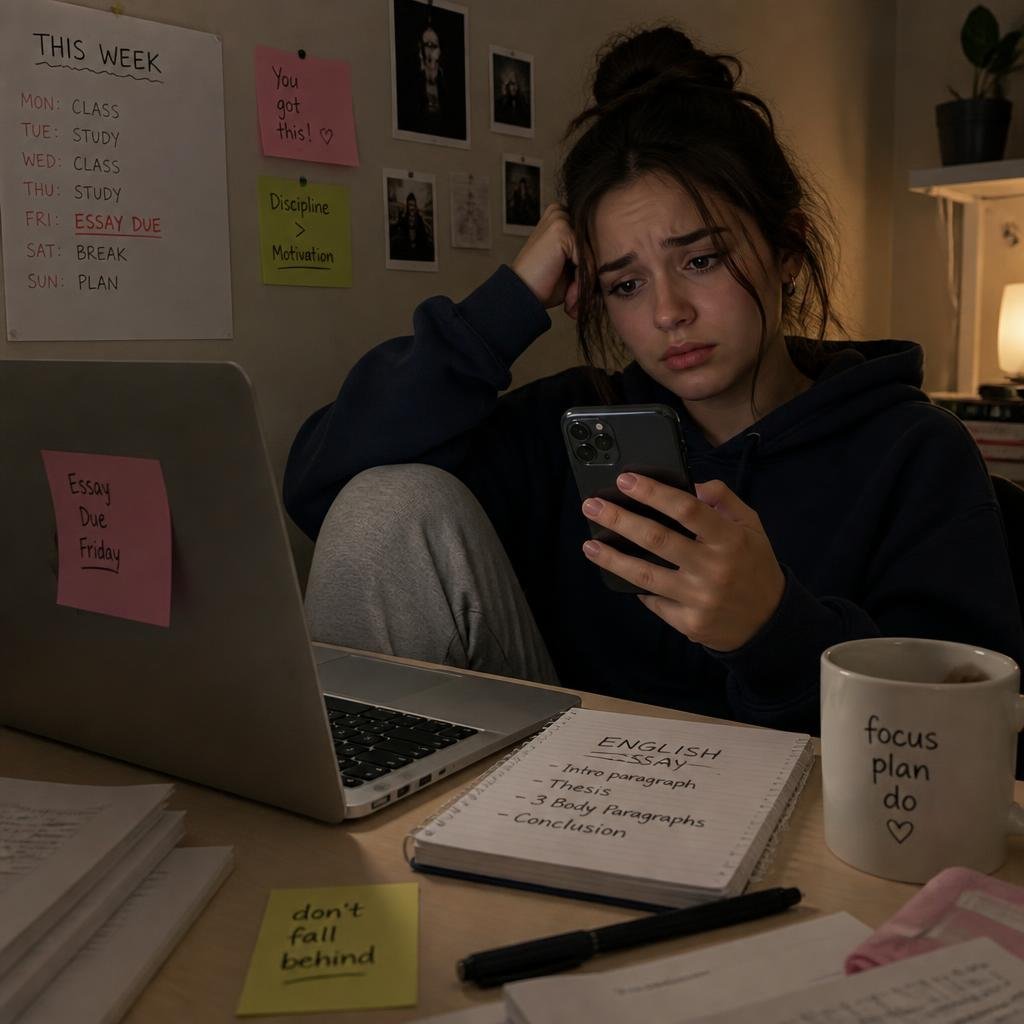
It could start with anything. Maybe it’s an email you’re avoiding, an exam creeping closer. Or a project you can’t ignore forever. And even though you’ve been thinking about it all day, you just can’t start.
It’s not like you don’t care, but suddenly a thousand other things are holding your attention, and reorganizing your closet at 11:47 PM starts feeling urgent.
The task sits there, taking up mental space. The longer it waits, the heavier it feels.
If you’ve ever wondered: “Why do I keep doing this even when I know it’s hurting me?” You’re asking something most people never do.
Because procrastination is rarely about laziness. Often, it has almost nothing to do with laziness at all.
The Strange Thing About Procrastination
Most people procrastinate on things they actually care about.
Nobody procrastinates on scrolling for two hours. Your brain jumps into that effortlessly. But tasks tied to goals, growth, expectations, or pressure, those are the ones your mind avoids.
That’s because the task began to carry emotional weight.
- An assignment becomes proof of whether you’re capable.
- An email becomes fear of saying the wrong thing.
- A decision becomes fear of regret.
When you sit down to start, your brain doesn’t think “time to work.” It thinks, “This feels uncomfortable.” And your brain naturally wants relief from discomfort.
Why Avoidance Feels Good (At First)
Procrastination works, temporarily.
The moment you decide “I’ll do it later,” you feel lighter. That relief might last minutes, but your brain notices. Over time, your brain learns: avoidance reduces stress.
Because your brain is trying to protect you from emotional discomfort in the quickest way possible.
But the relief is temporary, and the task doesn’t disappear. Now you have: the original task, plus guilt, plus pressure, plus the awareness you’re falling behind.
That’s how procrastination quietly turns into overwhelm and chronic stress.
The Loop Most People Don’t Notice
Something important comes up. You think about starting. Your mind jumps to pressure, fear of failure, and exhaustion. So you avoid it.
Later, because it’s still not done, your stress increases. The task feels heavier. Avoidance becomes more appealing.
Now you’re also dealing with shame, self-criticism, and anxiety about how long you’ve delayed. This is why procrastination feels exhausting even before you do any actual work.
🔗 Related: Breaking the Shame-Anxiety Cycle in Daily Life
Sometimes the Real Fear Isn’t the Task
This is what people don’t talk about.
Procrastination is often less about the task and more about what the task means.
Applying for a job isn’t just about applications. It’s avoiding rejection, disappointment, the possibility of trying hard and still failing.
Studying isn’t just studying. It’s avoiding the fear: “What if I give my best and it still isn’t enough?”
Research from the University of Sheffield shows that fear of evaluation is one of the strongest predictors of academic procrastination.
Two people can look at the same task, but completely differently. One thinks: “I should reply to this email.” Another thinks: “What if I embarrass myself?”
Same task. Completely different emotional experience.
Why “Waiting Until You Feel Ready” Keeps You Stuck
Many people wait for the perfect internal state: “I’ll start when I feel motivated.” “When I’m less overwhelmed.”
That moment never fully arrives. Motivation is unpredictable. Clarity often comes after action, not before it.
You keep expecting future-you to magically feel more energized or disciplined. But the emotional discomfort usually follows you into tomorrow too.
Why Being Hard on Yourself Backfires
When people procrastinate repeatedly, they often get harsher: “I’m so lazy.” “Why can’t I just do it?”
Self-criticism adds emotional weight. Now it’s not just “I need to finish this.” It’s “If I don’t, it proves something bad about me.”
Pressure increases avoidance. Especially when your brain already feels overwhelmed.
According to Dr. Tim Pychyl at Carleton University, self-forgiveness for past procrastination actually reduces future procrastination, while self-criticism makes it worse.
What CBT Helps People Notice
One helpful shift: move away from “What’s wrong with me?” toward “What’s happening right before I avoid this?”
Underneath procrastination, people often discover:
- anxiety
- perfectionism
- fear of failure
- fear of disappointing others
- mental exhaustion
- Laziness
When you really observe what your procrastination is responding to, you’re better able to handle it. Is it emotional discomfort or a “bad habit” you have groomed, the pattern becomes clearer.
🔗 Related: How CBT Rewires the Procrastinating Brain
A Different Way to Approach the Pattern
Sometimes the goal isn’t forced discipline overnight. It’s reducing the emotional intensity around the task. That might look like:
- making the task smaller
- lowering perfection pressure
- focusing on starting instead of finishing
- noticing catastrophic thoughts instead of believing them
When the emotional weight decreases, action feels more possible. Not effortless. Just less threatening.
How You Should Be Thinking
Procrastination can look lazy from the outside. But internally, it often feels like conflict: one part of you wants to move forward, while another part wants relief from pressure, fear, or overwhelm.
When you start understanding that, something shifts. You stop seeing yourself as the problem. You get curious about what your mind is reacting to.
And sometimes all you need is a little help to get you to see yourself clearly and develop better perspectives.